Frequently Asked Questions About Scopes

Frequently Asked Questions About Scopes


-Technical note prepared by NIPON Scope & Optics regarding telescopes and spotting scopes


1. Can I attach a digital camera to the scope?


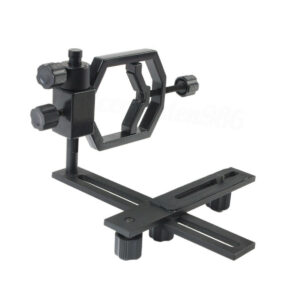
There is an increasing requirement for attaching digital camera to a scope to take pictures of distant objects. You can achieve this by hand holding the camera, for example, or mounting the camera on a tripod next to the telescope eyepiece, building or buying an adapter to hold the camera over the eyepiece, using a universal camera adapter (available from this shop), or using an eyepiece with built in adapter to attach it directly to the digital camera. Or simply, you can use a digital eyepiece which takes pictures and video footage directly through the scope.

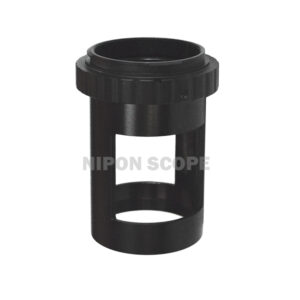
The Nipon 26-78x78 compact scope has a built in eyepiece adapter with a 1.25" (31.75mm) slip socket as an eyepiece holder. With this adapter, you can either fit a digital eyepiece/camera or fixed power optical eyepieces to this scope (these products are available from this shop). This adapter also allows a standard-design T-mount SLR and CCD camera adapter (with 1.25" fitting) to fit into its eyepiece holder.

You will need to purchase a standard T2 mounting ring separately for your particular camera brand from the camera's manufacturer. Please contact us (sales@nipon-scope.com) should you need further information about the adapters of your particular type of cameras.

Alternatively, you can use a universal digital camera adapter to connect your camera to the scope. Please browse the product category "Universal camera adapters" for more information.

2. What is the USB digital eyepiece/camera for Nipon scopes?


This is a digital device which can fit the Nipon 26-78x78 scope, and the Nipon 70/350mm scope, and connect the scope to a desktop/laptop computer through a USB cable. You can see a distant object on the computer screen, adjust the scope's magnification power from your computer and take pictures. You can also make a video recording of distant scene and save the video file (.avi) into the computer. This digital eyepiece has a standard fitting interface with eyepiece adaptor (i.e., diameter=1.25" or 31.75mm) that can be fitted to a spotting scope or telescope as long as the scope has such a 1.25" eyepiece holder.

This digital device comes with relevant software programme and it works under Windows 2000, XP and vista. There is also a detailed user guide about how to set up and use the system. Please view the Product Details page for more information about this product.

3. How to calculate magnification (or power) of a Nipon scope?


1. Identify the focal length of the scope. This is often marked on the body of the scope or it should be given in the user manual. For example, the Nipon 26-78x78 scope's focal length is 780mm.

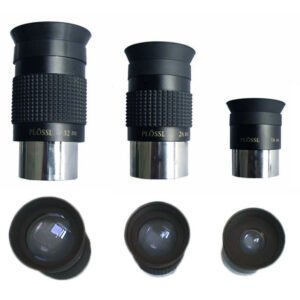
2. Find the focal length of the eyepiece. For example, for the PL16, PL26 and PL32 eyepieces as listed at nipon-scope.com, their focal lengths are 16mm, 26mm and 32mm, respectively.

3. Divide the focal length of the scope by the focal length of the eyepiece to get the magnification of the scope. For example, if you wish to use a 16mm eyepiece to replace the 26-78x zoom eyepiece of the above Nipon scope, the magnification of the scope will become: 780/16=49x.

It is desirable to have a range of eyepieces with different focal lengths to allow viewing over a range of magnification levels.

Please keep in mind that, as a fundamental law of optics, at higher magnification powers an image will always become dimmer and less sharp. With every doubling of magnification you lose about half the image brightness and 3/4 of the image sharpness.

Therefore, it is best to begin viewing with the lowest power eyepiece (with longest focal length, eg. 32mm of the above example) or with the zoom eyepiece being adjusted to its lowest power level. This will provide the widest true field of view which will make target finding and centring much easier. After you have located an object, you can switch to a higher power eyepiece (with smaller focal length) to see more detail (if atmospheric conditions permit). If the image you see is not crisp and steady, reduce the magnification by switching to a longer focal length eyepiece, or for a zoom eyepiece, zoom out. In general, a small but well-resolved image will show more detail and provide a more enjoyable view than a dim and fuzzy, over-magnified image.

Please refer to "How to calculate the field of view" for more related information.

4. What is the maximum magnification power a telescope or spotting scope can achieve?


As described above, the higher the magnification level, the dimmer an image becomes. There is thus a golden rule for the maximum usable magnification (Mmax) of any scope: Mmax=2 x D (mm)

Where: D is objective lens diameter measured in mm.

For example, for the Nipon 26-78x78 compact zoom scope, its objective lens is 78mm, so the maximum usable magnification power of this scope is 2x78=156 times.

5. How to decide the smallest eyepiece a scope can use?


Based on the Mmax value as calculated above, you can decide the minimum eyepiece focal length that you may wish to use for a scope. The equation is:
f = F / Mmax

Where: f is the minimum eyepiece focal length (mm); F is the focal length of the scope; Mmax is the maximum usable magnification of the scope.

For the Nipon 26-78x78 scope, the minimum eyepiece which can be used is: f=780/156=5 mm. This would provide about 156x power which is nice for viewing Mars or resolving the rings of Saturn. To resolve Saturn's rings, you may only need about 30x power, but to see them more clearly, higher magnifications are required.

6. How much magnification do I really need to get a good image?


If the visual condition is good (eg. on nights when the sky is clear and stable), the top usable magnification for a 60mm (2.4 inch objective lens) scope will be around 2x60=120x. This is more than enough to see the rings of Saturn, cloud belts on Jupiter and many star clusters and nebulae. So, 60mm scopes have been the standard size for a wide range of applications. Two types of these models are available at nipon-scope.com, one is Nipon 15-46x60 Spotting Scope, the other is Nipon 700x60 Telescope.

With a 70-80mm scope, however, the amount of light it gathers is about 55-65% more than a 60mm scope. This improves image quality especially when viewing at high powers and under low light. A selection of these models includes Nipon 20-60x70 spotting scope, 70/300mm refractor scope, 70/350mm refractor scope, and 26-78x78 compact zoom scope. In general, larger scopes outperform smaller ones, but they also tend to be bigger and heavier, and more expensive.

7. How to calculate the field of view of your scope?


1. Find out the value of the apparent field of view of the eyepiece. Every eyepiece has its own value of the apparent field of view and this value is supplied from the manufacturer. For the optical eyepieces PL16, PL26 & PL32 as mentioned in the above example, their apparent field of view is 52 degrees.

2. Find the value of magnification. This is calculated by dividing the focal length of your scope by the focal length of the eyepiece. For the Nipon 26-78x78 scope (focal length=780mm) with a 16mm eyepiece, for example, its magnification will be: 780/16=48.75.

3. Divide the value of the apparent field of view by the value of magnification. For the above example, 52/48.75=1.06 degrees. This is the value of the field of view for this scope using this eyepiece.

8. What's the difference between angled and straight eyepieces?


The Nipon 20-60x70 scope comes in either straight (horizontal) or 45 degree angled eyepiece designs. Straight scopes used to be the norm of these scopes, but angled scopes seem to have taken over for a majority of users nowadays.

With a straight eyepiece design, you can view the target in line with the central line of the scope. It is thus convenient to use the scope with straight eyepiece to locate and track a target, especially when the target or the viewer is moving.

Angled scopes can better accommodate people of different heights, and they seem to be easier to use for digi-scoping (eg. to mount a digital camera). Nevertheless, either option is strictly a personal choice, and both options are available from this shop.

9. Should I go for zoom or fixed power scopes?


Most Nipon scopes are available with zoom or fixed power eyepieces which can vary from 9x to 78x. Scopes with zoom eyepieces have become popular in recent years especially for many bird watching. It's easier to find your object at low power (which gives a wider field of view) and then zoom in to see more details. This gives you much convenience and saves you trouble changing eyepieces for different magnifications.

However, it should be noted that even though zooms are optically very sharp, they have a relatively narrower field of view as compared with fixed power eyepieces at the same magnification level. Looking through a scope with a fixed wide angle eyepiece (eg. 32mm) is a joy with a bright and wide visual field! If you put two scopes together, one with a 20-60 zoom set at 30x power, the other with a 30x fixed power eyepiece, the difference is striking. You can actually get a wider field of view in the 30x fixed power eyepiece than you will with the zoom eyepiece even when the zoom is set at 20x.

In addition, at the higher end of the zoom power, the image tends to become fuzzy or blurred. This is normal because the amount of light which comes through the objective lens remains the same regardless of the zoom levels. As the image is magnified, the amount of information that contained within the same area of the image is reduced. Therefore, to get a good quality image, either zoom out, or use a fixed power eyepiece.

That's why we have provided a set of fixed power eyepieces as optional accessories in our store, with 16mm, 26mm and 32mm focal lengths. They can add greater values to your scope.

10. Why an image seen through a Finder Scope is often upside-down?


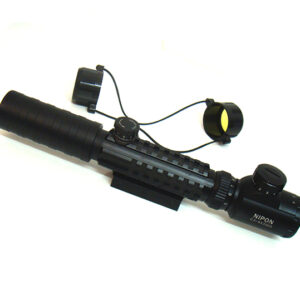
A “finder scope” is included in some telescope packages, such as the NIPON 350x70 and NIPON 700x60 telescopes. A finder scope is a small telescope that is attached to the main telescope. Its purpose is to aid in aiming the main telescope toward objects of interests such as a particular star. A finder scope is built with low magnification (eg. 2x, 3x, 5x etc.) but with a wide field of view (5 degrees or more), thus allowing you to see more of the sky than you can through the main telescope. Therefore, the finder scope enables you to locate a star more easily and centre it on the crosshairs, you can then view more details through the main telescope.

Beginners are often surprised that the image in a standard finder scope is upside-down when viewing objects on earth. That’s normal for any refractor used without a correction prism. For most astronomical observation, it makes little difference if an object is seen upside-down or at an otherwise odd angle because there is no “right side up” in space, since all you are trying to do is to centre the object on the crosshairs so that you can view it through the main telescope.

A relatively new type of finder scope is known as a reflex sight, or "Red Dot" scope (as included in the Nipon 700x60 telescope package). It is a non-magnifying device that displays a red, LED-lit bull's-eye pattern or red dot in the center of the field of view. The red dot appears superimposed on the sky, showing exactly where the telescope is pointed (once the finder scope and the main telescope are properly aligned, of course).

11. How to align the finder scope with the main scope?


The finder scope only works to its purchase when it has been aligned with the main scope, so the two are aiming at exactly the same spot. This is easy to do.

It is more convenient to align the finder scope while it's still light outside. A good time to do it is after the telescope has been set up but before the Sunset.

First, put a low-power eyepiece (with long focal length) in the eyepiece holder (focuser) of the main telescope. Looking into the eyepiece, centre a distant object in the field of view — the top of a telephone pole, a treetop, or a chimney on a house. The object should be at least a quarter-mile away. Now look through the finder scope and see if the object appears in the centre of the finder's field of view (where the crosshairs intersect). If it does not, use the adjustment screws on the finder scope bracket to adjust the aim of the finder until the object is centred. Then, look back into the telescope eyepiece and make sure the object is still centred there as well. If so, you're done. If it is not, repeat the procedure, being careful not to move the main telescope while you're adjusting the finder scope positioning.

When the distant object is centred in both the main telescope and the finder scope, the finder scope has been properly aligned and ready to use. Verifying the finder's alignment should be one of the steps you go through each time you set up for an observing session.

12. What are the Bak4 and Bk-7 prisms? Is there a difference when they are used in scopes and in binoculars?


Both Bak4 and Bk-7 are common types of brown glass used in prisms that fold the light path inside the scopes and binoculars. “Bak” represents “Barium light Crown” glass, while “Bk” represents “Borosilicate Crown” glass.

In general terms, Bak4 prisms are more expensive and are considered better because they give a smooth, rounded “exit pupil”, due to a slightly higher level of refraction than Bk-7. Bk-7 prisms are also good quality, but brightness falls off slightly at the edge of the field compared to Bak4, so they create a slightly square exit pupil. Sharpness and clarity aren't affected by using BK-7 and only the outer edges of the exit pupil are shaded (blurred). If your eye pupil is closed to a size that fits within the unshadowed diamond shape inside the exit pupil there is no loss of light at all with BK-7 prisms compared to Bak4.

However, BaK4 is preferable to BK-7 as a prism glass only when the focal ratio of the objective lens falls below about f/5. Virtually all scopes have focal ratios above f/5, so there's no disadvantage in using BK-7 prisms. It achieves total internal reflection just as well as BaK4. In some telescopes it's actually a slightly better choice because a prism made with BK-7 has a little less spherical overcorrection and chromatic aberration at blue/violet wavelengths than BaK4.

For binoculars, their objective lenses are mostly around f/4 or less, so BaK4 is preferred for their prisms to achieve total internal reflection at the edges of the fast f/4 light cone. Whist the binoculars with the Bk-7 prism would look no difference to the Bak4 in daylight condition, as the light levels drop, and the eye pupil expends, you start to observe the effects of the shaded regions as the image quality drops and becomes prone to chromatic aberration around the periphery of the image.

-------------------------------------

NIPON SCOPE & OPTICS

www.nipon-scope.com

Please Email Us with your comments and suggestions. Thank you!

Back
Copyright © 2010 NIPON SCOPE & OPTICS. All rights reserved.
Nipon Scope & Optics is a trading name of Nipon Optics (UK) Limited, a company registered in England & Wales, No. 07291656.